Showing posts with label Technics. Show all posts

Tuesday, November 8, 2016

Capturing Architecture in Art

Every once in a while someone comes along with a fresh, invigorating approach to art and architecture. Chris Musselman is carving out an artistic niche with a unique rendering style that will be of interest to architects, builders, and marketing professionals.

I became aware of Chris through a series of renderings published in Modern in Denver magazine. His illustrations focused on the Denver neighborhood of Arapahoe Acres. This 1950s-era community is on the National Register of Historic Places. It is a beautiful example of mid-century modern architecture. I decided to track Chris down to commission a rendering of my own home. His phone contact  contained an out-of-state area code and his tracks ran through Chicago and Santa Fe.  But it turns out he now lives and works in my town, Denver, Colorado.

Chris applies a spare graphic approach to architectural renderings, with lots of atmospherics and a lively sense of color. His technique is highly stylized but approachable. Here is a link to his website: www.christianmusselman.com. And here is the rendering he produced for my house.

Architectural rendering by Chris Mussellman. 
Thanks, Chris!

Friday, November 4, 2016

Architecture Podcast

Our friends at Mountain View Windows and Doors run a regularly schedule podcast about architecture, design, building, and business. The Art of Construction podcast continues to grow and develop and has become the #1 podcast on iTunes for contractors and architects.  With their increased success they have decided to give it is own home/website: the art of construction.net

With this is mind, the link to their interview with Michael Knorr has also changed: http://www.theartofconstruction.net/episode-38-with-michael-knorr.

Podcast hosts Kevin Keefe and Devon Tilly.

Monday, March 14, 2016

Great Architecture Requires Great Builders (Let's Talk About Competitive Bidding)

A question that regularly comes up with my new clients is how do I select a builder? accompanied by should we be getting competitive bids? I'm a firm believer in selecting a qualified builder right at the beginning as part of your design team. This should be done when your plans are being created so the builder can contribute his/her expertise in planning the project. This will be helpful in establishing the budget. The builder can guide wise choices in specifications, materials, and capabilities of local craftsmen. Obviously, it is impossible to obtain competitive bids at this stage because there are no completed drawings from which to bid. Of course, it's logical to wonder how selecting a builder so early will give you someone who is going to be cost competitive. Putting it bluntly, how do you know you're getting a good and fair deal?

If we are talking about custom homes (the bulk of my work) there are many ways you can find a builder that you can trust, even before you know the final cost. First, let's clarify some terms. Builder and general contractor are used interchangeably, but most builders of custom homes are more accurately described as construction managers. Few custom builders are actually in the field swinging a hammer, installing electrical conduit, or roofing the structure. They are subcontracting this work to (what should be) qualified, licensed subcontractors. The construction manager will coordinate the construction and will make a profit on fees or on a percentage of the estimated budget. (More on that in a moment.) Where the budget can be controlled is amongst the subcontractors. You want to be certain that your builder is getting competitive bids from qualified subcontractors and not just getting bids from the same people they always use because it's convenient for them. Determining that should be part of the client's due diligence. It requires checking builder references and talking to past clients. It also means that the bidding process should be transparent: all bids from subcontractors should be presented to the owner.

A client can certainly interview various builders (or construction managers) to determine who is best for them. But then choose one; don't make them fight for the lowest bid. The incentive in that scenario is to provide lowball prices using cut-rate sub contractors that may not be the best choices. In selecting a builder up front, there are three criteria you can use.

Reputation

Most people have friends who have built homes. That can be a starting point for interviewing prospective builders. You can also get names of qualified builders from your architect or interior designer. Good references are important, but you need to dig deeper. Talk to other people who have had homes built by your prospective builder. Were they satisfied? Did they have any problems? Was the builder diligent in seeking the best prices from subcontractors (as described above)? How do they handle change orders?

Fee

There are many ways to set up a contract between owner and builder. Percentage of cost,  fixed fee, and combinations of those two. Some builders charge penalties on change orders; that part of the contract should be clear and understandable. None of these methods are good or bad of themselves. It depends on what you are comfortable with. When comparing builders, you want to know the details of their fee basis. You want to be sure they offer a business deal that works for you. Also, keep in mind that any proposal is negotiable in the details.

Rapport

Finally, ask yourself how comfortable you are with any prospective builder. Constructing a house is a long term relationship. You want a builder who is honest, trustworthy, and true. Don't be misled by superficial gregariousness. You don't need your builder to be your BFF, but you do want someone you feel good about and can have direct conversations with during the good and the bad periods of getting your project completed. If you've done your homework on reputation and fee, then your gut feelings about who you want to work with are also important.

After all this due diligence, you might continue to wonder about getting competitive bids. I still think the answer is no. The bidding competition will take place anyway on the subcontractor level. The chief builder - the construction manager - is hired to get the best prices from the most qualified subs. For a more detailed explanation, Steve Jones and Bart Jones (my friends who own Merlin Contracting in Las Vegas, Nevada) have a great article on competitive bidding in their on-line newsletter. It is one of the best-reasoned discussions I have read on the subject. If you are about to build a new home or are just curious about the process, please click on this Merlin Contracting link to read more about competitive bids.

Building a new home can and should be a happy experience. Hopefully you have chosen an architect who can perform. Great architecture also requires great builders. Make your builder part of the design team as early in the process as possible.
Traditional home designed by Michael Knorr, built by Merlin Contracting.
Contemporary home design by Michael Knorr, built by Merlin Contracting.
Bart Jones & Steve Jones of Merlin Contracting.

Monday, April 20, 2015

Alien Architecture at Sacsayhuaman

1. Large scale terrace walls at Sacsayhuaman.
Previously we explored the idea of ancient extraterrestrial artifacts at two sites: Palenque, Mexico and Nazca, Peru.

The third interesting site I keep returning to in my mind is Sacsayhuaman, Peru. It is the most remarkable of the sites referred to on the History Channel's Ancient Aliens that I have actually visited. Located at an elevation of 12,000 feet a short distance north of Cuzco, Sacsayhuaman was an Inca fortress. It is now in ruins, plundered, as usual, by the Spanish conquistadores.  Besides killing countless native South Americans, they looted the Inca culture for gold and silver, drove the native religion underground, and decimated their monuments. The conquistadores did a thorough job of plundering Sacsayhuaman, hauling away anything that was movable. What remains is not movable and that is what is remarkable.
2. Juan de Dios, Peruvian guide at Sacsayhuaman. 
Sacsayhuaman provides compelling evidence of technologies beyond the abilities of a culture that didn't even have the benefits of the wheel.*

Consider that the battlement walls of Sacsayhuaman are built of enormous andesite stones found nowhere near the site.  They are believed to originate from several quarries ranging 12 to 46 miles distant.  The largest stones weigh 128 to 200 tons. They were apparently hauled -- somehow -- over severe terrain. Conventional theories on transporting them usually mention a combination of ropes, ramps, and the labor of hundreds or thousands of workers. The details vary, because nobody really knows for sure.
3. Stone work detail.
4. Along the battlements. 
The stones are shaped not into squares or rectangles or any regular geometry, but into puzzle-like pieces with precisely rounded edges. Then - the most astonishing aspect of the whole thing - these misshapen pieces are lifted to great heights and assembled perfectly without mortar.  The results are so precise you can't slip a dollar bill (or a Peruvian Nuevo Sol) between the joints. Or, as Pedro Pizarro (brother of the conqueror Francisco Pizarro) said of Sacsayhuaman, "...the point of a pin could not have been inserted in the joints."
5. Remnants of a portal.
When I encountered Sacsayhuaman my first thought as an architect was, I don't know how I would begin to go about designing this today. How would one do working drawings, even using computers?  How would the masonry contractor react?  You want me to ship these 200 ton stones forty miles? Then carve them into absurd shapes? And set them flawlessly? Buddy; that ain't gonna happen no matter how many ropes you give me!

Even if one would and could draw it, where would an architect find the technology and craftsmanship to build it? The enterprise isn't rational.  It would be much simpler to use regular sized blocks with regular shapes and stack them together like other masonry structures. Using the most sophisticated techniques available to modern man, Sacsayhuaman seems impossible. So how the heck did the Incas ever accomplish such feats?
6. Terraces form the base of Sacsayhuaman. 

7. Rocks above the main terraces were removed by the Spaniards to build
homes and churches in Cuzco.  What remains was too big to move using
technology available to the conquistadores.
Ancient Aliens suggests, of course, that the Inca had help from ancient aliens. Their reasoning rests on the premise that humans couldn't have constructed it (because we didn't possess the skills or technology) therefore a different intelligence must have provided assistance.  The back-up evidence, as in all Ancient Alien episodes, includes other artifacts, carvings, or connections to distant sites that suggest extraterrestrial life forms. It is all conjecture, put forward by "ancient alien theorists" as if that were equivalent to "respected archaeologists."  As stated previously, all of this is frequently debunked on line; the evidence is not as airtight as the TV program would have it.

However, the case for ancient aliens, as evidenced at Sacsayhuaman and numerous other sites, is strong enough to make you wonder about it. For me, Sacsayhuaman is a place of great mystery. I don't understand exactly how or why it was built. I don't buy the explanations of mainstream historians and archaeologists; they seem as facile and contradictory as those offered by "ancient alien theorists." But that doesn't mean I accept the ancient alien hypothesis. The best I can say is I don't know how it was built and I don't think anybody does for sure.

Did extraterrestrials assist in the architecture and construction of Sacsayhuaman?  Maybe they did and maybe they didn't.
8. Terrace walls. 
* The wheel is said to have been unknown to native cultures in pre-Hispanic South America.  However, I saw what appeared to be an ancient wheel in nearby Ollantaytambo.  But that's another story. 

Images:
1. David Galsworthy
2-5. MJK
6-8. Luis Manuel Moll Juan

Sunday, March 29, 2015

Alien Architecture

Ancient Aliens

A popular show on cable TV is Ancient Aliens airing on the History channel. The show posits that ancient civilizations, such as the Egyptians and the Incas, produced architecture and artifacts that were too sophisticated to have emerged solely from human intelligence and abilities.  According to the show's explosively coiffed narrator,  Giorgio Tsoukalos, these great civilizations must have had assistance from a more advanced source: ancient aliens from another world. The evidence presented for this idea is sourced from vanished cultures around the world. If you are familiar with the theories of Erich von Daniken, you know the show's basic premise.
1. George Tsoukalos.
I got hooked on the show because the presentation of this evidence involves field trips to ancient ruins around the globe and computer-generated reconstructions of architectural monuments. It is worth watching as an exciting architectural travelogue if for no other reason.

Of course, the show has its debunkers. You can easily find on-line critics who delight in identifying inconsistencies within the show and errors of historical fact. These comments must be weighed against the contentions of the show's gaggle of scientific "experts" who are eager to claim any mystery as evidence of other-worldly intelligence.

When looking at ancient cultures there are bound to be mysteries.  Too much information has been lost to time to be able to fully understand how people in the distant past thought, how they lived their lives, and exactly how they built the monuments they left behind.  Sometimes it is better to say we simply don't know something than to build explanatory tales around tiny shreds of evidence.  There is much conjecture propping up in every episode of Ancient Aliens. That is not the same thing as scientific evidence.

And yet...

Sometimes the evidence is seductive. It occurs to me that - as an architect  - I could be one of the "experts" on this show. I am certainly as qualified as any of the UFOlogists introduced on the History channel. I have the professional qualifications to offer opinions on the built environment. And I have visited many of the sites that are of frequent interest to the show's producers:  Machu Picchu, Stonehenge, Chichenitza, Palenque, the Nazca Lines, Teotihuacan, Stonehenge, Sachayhuaman. So here it goes: I'm weighing in on the general thesis of Ancient Aliens.

Have great human endeavors in the past been aided by intelligent life from other planets?


Palenque

2. Temple of the Inscriptions. Palenque, Mexico. 
Of the ancient sites featured on Ancient Aliens that  I have actually visited, three stand out.  The first is the Mayan ruins at Palenque, Mexico.  Set deep in a misty jungle, Palenque possesses a movie-set romanticism that encourages other-worldly thoughts.

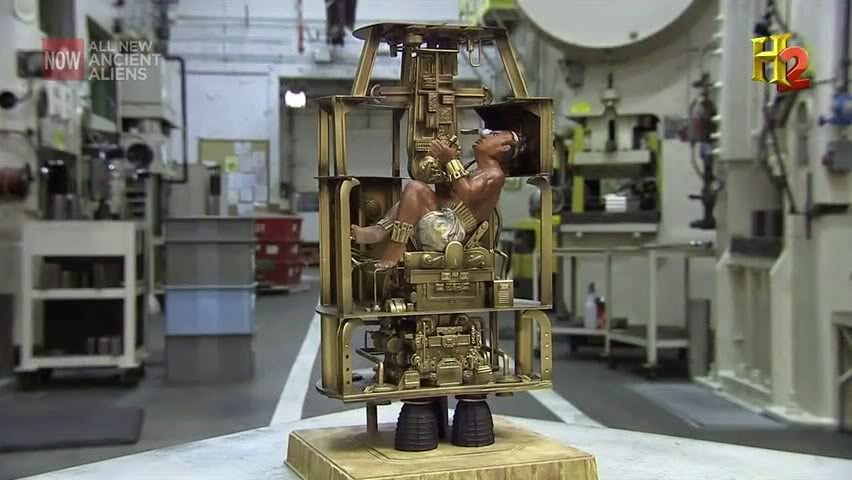
Discovered within the Temple of the Inscriptions at Palenque in 1952 is a limestone sarcophagus bearing the engraving of an "astronaut".  Dating from about about 683 A.D. it is a big piece of evidence favored by ancient alien theorists. The tomb is no longer accessible to visitors due to concerns about humidity damage to the carvings. (There is a replica of the burial chamber , including the sarcophagus cover, in Mexico City's Museum of Archaeology.) When I saw this image in Palenque I thought,  yes, it does look like a depiction of an astronaut.  There he was, reclining in some sort of capsule, connected to life-support systems, apparently controlling what looks like a flame-propelled vehicle.  It is quite astonishing, but who knows what it really represents?  Debunkers have said it is simply a depiction of the transition to the afterlife using common Mayan symbols.  Even if it is an astronaut, is it an alien astronaut or a human astronaut? Historians could certainly fashion any number of theories about this one image; it would be impossible to know for sure. Of course, the proponents of ancient alien influence on humans don't rely on this single piece of evidence. However, I would only rate this tantalizing tidbit five on a scale of one to ten on the ancient alien evidence scale.
3. Sarcophagus cover at Palenque.
4. Detail. 
5. Three dimensional model featured on the History Channel.
6. Close up of 3-D model. 

Nazca

The second site that impressed me was the Nazca Lines in the Atacama desert of Peru. Created between 400 and 650 A.D. these lines form images of birds, spiders, fish, monkeys, lizards and other animals. Some lines look like directional information for navigation.
7. Hummingbird.
Other artificial formations in the region look like landing strips. These glyphs are only fully visible from aloft. People ask why are they here? What are they for?  To some, the only logical explanation is signals to creatures who had the technology to fly, i.e. ancient aliens. There are other explanations, of course. When I was there a popular theory was that these were ritual paths carved into the desert by hundreds of footsteps tracing their way over and over again. Sort of like walking the labyrinth in the cathedral at Chartres. This does seem possible. It would not take elevated sight to work out the geometry of a path that formed a recognizable image. That might explain how the images were created; it still leaves questions of why and for whom. Keep in mind these images are huge and many. And it is not just lines, it is rock formations and altered  landscapes in the surrounding hills that are provocative.  The Nazca lines, taken as a whole,  seem beyond the abilities of the humans formerly inhabiting this area. However, it could be that we under estimate those abilities. Or, at least, misunderstand the cultural needs of those people. The lines are suggestive evidence for extraterrestrial intelligence, but I don't think we can call it proof. I'll rate this site another five on the ancient alien evidence scale.
8. "Landing strip."
9. Spider image in center of image surrounded
by seemingly random straight lines.
10. Bird image.
11. Map of Nazca lines.

Sacsayhuaman

Finally, the third interesting site I keep returning to in my mind is Sacsayhuaman. Located at an elevation of 12,000 feet it is a short distance north of Cuzco, Peru, Sacsayhuaman is an Incan fortress (in ruins).  For me, this site offers more compelling evidence of technology beyond the abilities of a culture that didn't have the modern machines or even the benefits of the wheel.

We'll explore Sacsayhuaman in the next blog entry.
12. Author at Sacsayhuaman.
Photos:
1. History channel.
2. Tato Grasso.
3-4. Unknown.
5-6. History channel.
7-10.  MJK
11. Unknown.
12. MJK

Friday, September 20, 2013

Architectural Sketches

My office was recently awarded a contract for the redesign of a high-rise condominium unit. We will demolish all remnants of the previous floor plan and start from scratch within the demising walls. We could not locate an existing computer aided drafting (CAD) file for the original project, so we are forced to create a new Autocad file from measurements for our "base" drawings. No big deal, except that our client is in a hurry to get started with the design and asked if we could move forward with "freehand sketches on tracing paper."
Freehand sketches! Who does such a thing? The days of hand-drafted architectural sketches are nearly gone. Certainly, we don't dare present an unpolished, manually-drafted sketch to a client. Today we produce crisp, clean, seemingly perfect images using our CAD programs. But something is missing from these perfectly pretty images. (I hesitate to call them drawings. Are electrons arranged on a screen, or reproductions from ink jet printers, really drawings?)
Sketch for a condominium. 
Years ago I went to a museum exhibit in Dallas of Frank Lloyd Wright's hand-drafted plans, elevations, and perspectives. Many of them were rough, colored pencil scrawls where you could see that the image in the architect's mind had directly connected to his moving hand and been impressed upon the paper. These were drawings I had seen reproduced in books many times, but that was nothing like being in the presence of the actual, full-scale drawings. You could smell the paper they were drawn upon. You could see the thick pencil lines, the smudges, the erasures, the overlay of multiple ideas in different colors. You could see the birth of ideas. I felt that I had to touch these drawings and be connected to them. Against all well-known museum rules, I did touch one.  No alarms sounded and I felt a direct link to my architectural patrimony.
Today I pull out my Prismacolors (the same brand of colored pencils used many decades ago by Wright) and begin sketches for our new project. It is a large condo unit, 4000 square feet. Multiple ideas spill out, and the hand moves as rapidly as the mind. No computer modeling is yet as quick as the mind/hand connection.  I have not seen an ap or a program that allows for the uncertainties of the design process as does freehand sketching. The sketchy line holds multiple meanings and suggestions that do not reside in the mathematics of a CAD-generated line.  Don't get me wrong. I embrace the brave new world of electronica. There is much to be said about melding our brains -- as we are doing -- with electrons in a box.  But we are not yet at the point of loving these electrons in the same visceral way we can love a hand-drawn sketch. Perhaps we will be soon. But, for now, human touch, whether from one human to another or from a human intelligence to paper, is a richly deep and unique experience. It may not be irreplaceable, but it is incomparable.

Tuesday, June 18, 2013

God's Architect: Antonio Gaudi

Spanish architect Antonio Gaudi has been mentioned several times in this blog. He worked in Barcelona a century ago, creating sensuous buildings with undulating walls, colorful mosaics, and unconventional spaces.  His work is variously categorized as art nouveau, modernist, or uniquely Catalonian. Gaudi's masterwork is the Sagrada Familia basilica. Frank Lloyd Wright dismissed the ornate forms of Sagrada Familia as "architecture with a laxative." I believe Gaudi was the last great Gothic architect: structurally disciplined but unaffected by tradition. View the video at this link to judge for yourself: God's Architect: Antonio Gaudi's Glorious Vision - 60 Minutes - CBS News. The thirteen minute video reveals the splendor in Gaudi's mind that is gradually being realized after 130 years of construction. It reveals his genius more than is possible with static photographs. Some believe Gaudi's total vision for Sagrada Familia may actually be completed in another thirteen years. But we can already see what God's architect had in mind.
One of four main facades at Sagrada Familia.

Columns and ceiling.

Organic engineering.
Images:  R. Munger

Tuesday, April 2, 2013

Architecture is Like the Movies

One of the best architecture magazines on the market today is Hospitality Design, published by Nielson Business Media. It is a trade publication that specializes in hotels, restaurants, resorts, and spas, intended for professionals who design or manage such venues. While not specifically an architecture magazine, it features architecture and interior design regularly and lavishly.

The hospitality industry is highly competitive. To stay on top, popular venues are revamped every few years. The half-life for architecture and interior design in the hospitality game is short. New ideas are introduced at lightening speed and creativity thrives in this environment. At top restaurants in New York and L.A. and big resorts on the Vegas strip, there are ample funds to support leading edge ideas. Good design is used as a marketing tool without hesitation - in fact, with a sense of obligation. For these reasons, Hospitality Design features exciting architectural concepts in nearly every issue. It is a "must read" for me.


I was struck by a statement in a recent issue by hotelier Grace Leo: I see myself as a movie producer - but I produce hotels. I orchestrate everybody's efforts to make the vision a reality.


Comparing the creation of a hotel to making movies strikes close to home.  I have often used the simile, aarchitecture is like the movies.

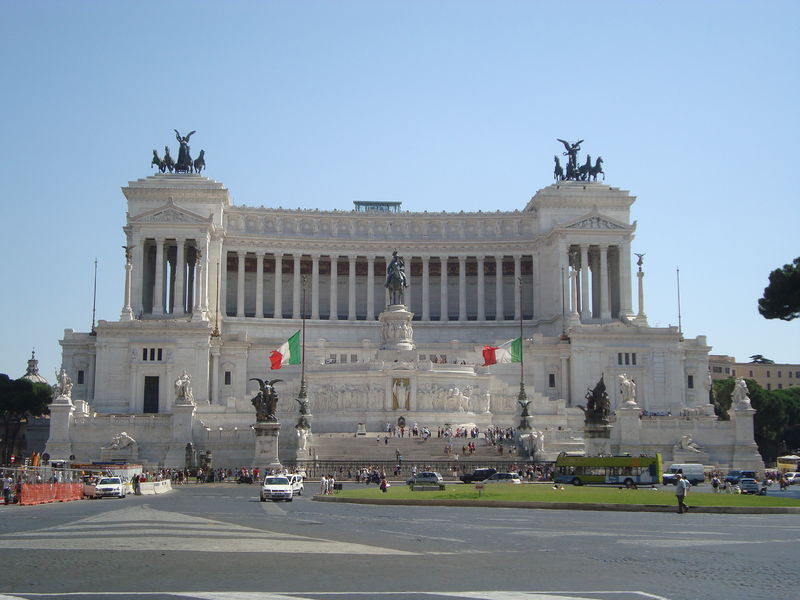
Architecture is a complex art. It interweaves the talents of many different professions, trades, and consultants. Like the movies, all of these entities must work in concert at top capacity to produce a hit. A great movie must have a great script (the design) but also a willing client (the producer), talented actors (craftsmen), and a capable director (the builder). Add to this the many extras, bit players, FX artists, etc. that are necessary to make a movie and to make architecture. If any part of this assemblage falls short, a movie will be less than a blockbuster and a work of architecture will scar the landscape.  The movie world does not want another Water World. The built
Victor Emmanuel Monument. A study in architectural excess.
environment does not need another Victor Emmanuel Monument.


When Hollywood has a premier, everybody notices, but nobody has to watch.
When a building has a premier, it is hard to avoid and
it tends to stick around for a long time.
The simile is also something of a plea for tolerance for those works of architecture that fall short. Sometimes good architects produce bad works, but it is not always the architect's fault. Interior design can make a a good building look bad or a bad building look good. Landscape architecture can do the same. The budget has to be sufficient. The client must be willing and, sometimes, brave. This is not an excuse for architectural misfires, but a recognition of the importance of assembling the right team. Quality, talent, commitment go a long way in making good movies. They are requirements for good architecture. 

It is tempting to think of architectural successes as a brilliant tours de force that spring from the minds of lone auteurs. Certainly, credit should be given to great talents when it is due. In reality, however, the list of credits is usually quite long. 

Monday, March 25, 2013

Architecture and Living in the Future

Yesterday my business networking group met at the showroom of Exquisite Kitchen Designs. We were dazzled by the way technology has insinuated itself into the design, manufacture, and utility of kitchens.  The new kitchens we are installing in luxury homes are glimpses of a science-fiction future that ultimately will filter down to the average residence. 

It often feels like we are living in the future we imagined decades ago. In many respects we have surpsassed our imperfectly imagined future. Disneyland's World of Tomorrow exhibit  has long been dismantled because it couldn't keep up with the real future that was happening around us.

Today I ran across this video - an extended ad for Corning Glass. This glimpse of a techno-friendly future (all of the technology shown in the video is possible right now) is worth a look. Pay attention to the backgrounds as well as the products. This is a future of sumptuously modern architecture.


Thursday, May 19, 2011

Glass in Architecture

For those of us who grew up with (and loved) Walt Disney's Tomorrowland, the Monsanto House of the Future, Bucky Fuller, and the architecture in Superman comics... this one's for you:
I usually avoid being a shill for manufacturers' products. But this vid by Corning Glass has great architectural appeal and presents an optimistic vision. It is a futurist fantasy of the world of tomorrow as it is now unfolding.

Saturday, July 24, 2010

Architecture and Virtual Reality

1.  Department of the Navy virtual reality training.
We cannot detach architecture from its environment and study it as an isolated object. The sounds and scents of nature contribute to the feelings we have about our buildings. The mood of the Golden Pavilion in Japan is very different from the surroundings of Villa d'Este in Italy.  Neither can be removed from its setting and maintain the same meaning. 

Yet there is serious talk about the idea that architecture might someday, somehow be replaced by virtual reality.  Read various architectural journals like Architecture or sci-tech magazines like Wired, and the idea crops up perennially.

For readers not wired into the terminology, this is how Wikipedia defines virtual reality:


2. Golden Pavilion (Kinkaky-ji), Kyoto, Japan.
Virtual reality (VR) is a term that applies to computer-simulated environments that can simulate places in the real world as well as in imaginary worlds. Most current virtual reality environments are primarily visual experiences, displayed either on a computer screen or through special stereoscopic displays, but some simulations include additional sensory information, such as sound through speakers or headphones. Some advanced, haptic systems now include tactile information, generally known as force feedback, in medical and gaming applications.


The Colombia Encylopedia has a similar definition.  They are basicaly saying that it is possible to create the experience of riding a digitally-simulated roller coaster, for example, that is indistinguishable from riding an actual roller coaster.  The two experiences would be identical. 

3. Garden of Ryoanji.  Kyoto, Japan.
Let's be clear about this:  the environment around a work of architecture contributes to its character.    Context matters.  Time and space affect architecture and become part of it.  For these reasons, VR will never replace architecture. 

Well, I should temper that assertion:  VR will never replace architecture unless and until we reach some sort of Matix-like level of experiential unreality.  (To coin a phrase.)  We're a long way from that event.

4. Villa d'Este.  Tivoli, Italy.
There will come a time when architects will use virtual reality to make presentations of their ideas to clients. The technology is already available, but the techniques are expensive and cumbersome. Will virtual reality ever completely replace architecture? Will a virtual Notre Dame substitute for the real thing? It will only if you believe that Walt Disney’s Epcot Center is a viable substitute for a tour of Europe. The real thing contains  too many layers of subtlety, nuance and detail – not to mention spontaneity and serendipity - to faithfully be replicated.  The muscular movement of negotiating steps, the feel of ambient sunlight on a wooden porch, the temperature of filtered light through a carved screen. These ways of experiencing architecture have nothing to do with vision alone or any form of virtual reality now possible. Architecture is a total immersion experience. A computerized substitute will be a great presentation or teaching tool. However, there will be no Star Trek-like holideck for architecture in the foreseeable future.
5. Vekomaboomerang steel roller coaster.

If a building does not evoke some sort of emotional or intellectual response it probably isn’t architecture. Architecture has meaning. That is what distinguishes architecture from mere structure and simple shelter.  And it will be what distinguishes real architecture from a virtual fake. 

6.  Trekkie Borg.
So, to all you trekkies, avatars, and simulacra out there:  fasten your seatbelts; you'll be riding the real architecture roller coaster for a long time.

Credits: 

1. Interior Dept.
2. David Monniaux
3. S. Fujioka
4. Mmxbass
5. Will McC
6. Bruno Girin 

Monday, August 17, 2009

Extending Architecture Into the Landscape

Many of my clients are familiar with the name Longshadow Classic Garden Ornaments, Ltd. Longshadow makes outdoor planters specified on a number of projects by Michael Knorr & Associates. On a recent road trip through the Midwest, I had an opportunity to visit Longshadow at their manufacturing facility near Pomona, Illinois. More on that in a moment. First, a description of what drew me to Longshadow in the first place and why we like to specify their product:

Architecture looks best when it connects to the landscape around it. Though architects usually aren’t directly involved in landscape design, the points of connection between building and landscape can reinforce an architectural theme. When architecture is extended into gardens, patios, terraces, and balconies, it becomes anchored to the earth. One way to accomplish this is by providing places for planters as illustrated in the two projects below.
Longshadow produces garden ornaments that lend themselves to this ethos. Their products are architectonic in design and scale. This means they almost look like part of the building. This is partly due to the manufacturing process, dry cast limestone – a method that goes back to structures in ancient Rome. It is also due to the care invested in the design of these products. Longshadow’s traditional designs use “ancient motifs of protection, life, and regeneration…. a symbolic language that has been shared for thousands of years about the fears and aspirations of all humans.” (Quotation from the Longshadow catalog.)
Longshadow also has an extensive Prairie School line which takes inspiration from the work of American architects such as Louis Sullivan, Frank Lloyd Wright, and Walter Burley Griffin.
We have found that in both contemporary and traditional architecture, products like this anchor our buildings not only to the ground, but also to history. They imbue architecture with a timeless quality.

Longshadow is located well off the beaten path in the verdant hills near Pomona, Illinois. You might expect to find a business like this housed in a hulking industrial plant. What one actually encounters is an idyllic hundred-acre farm. Instead of grey smokestacks, there are tree-lined allees. Instead of a confined factory there is a plein-air environment with peacocks, dogs, and kittens roaming freely. Owners Charlotte Peters and Daniel Ward grew Longshadow as an artistic enterprise. With about twenty employees they have created a successful business that reflects high ideals; they clearly love what they do. Because of their efforts, we get to select from quality products that amplify architecture. An array of planters, urns, fountains, birdbaths, and other garden ornaments are reminiscent of an era when architecture worked with all arts in a collaborative way. It is good to know that such opportunities are still available.
Longshadow Classic Garden Ornaments, Ltd. is certainly not the only producer of quality architectural products, but they are definitely one of the best. That is why it was a pleasure to visit the facility and meet Charlotte and Daniel.

To quote philanthropist Bill Daniels (out of context), “The best is good enough for me.” That’s the way I feel when Longshadow’s products show up on my buildings.

Credits: Top photo by Rob Munger; all others by MJK.