Architect Greg Walke sent us this meme circulating on the web. 'Nuff said.
Showing posts with label Architectural Oddities. Show all posts
Sunday, October 25, 2020
Tuesday, December 15, 2015
The Crazy Architecture in Dubai
When I was a kid I read as much science fiction as I could get my hands on by authors such as Robert Heinlein, Arthur C. Clark, Andre Norton, etc. At the same time, real life magazines like Popular Science, which I consumed like candy, promised a future filled with flying cars, personal robots, and fantastic architecture.
I also devoured sic-fi movies like The Day the Earth Stood Still and Forbidden Planet (the best movie ever made). It didn't help that my fourth grade teacher, Mr. Karp, predicted all sorts of inventions that would come about by the time I grew up. Specifically, he said it was all but certain a transporter machine the size of a telephone booth would whisk human beings from one place to another in the same manner a conversation traveled through phone wires. I am still waiting for this invention to materialize.
In other respects, it seems that the science fiction of yesterday is the reality of today. I marvel that we actually seem to be living in the world of tomorrow. Hand-held computers, personal robots (I have a Rumba that cleans my floors every day), and other stuff of the future is here now. Even our architecture resembles the cover of a science fiction novel from 1955. Not everywhere, but in many places. Especially in Dubai with the Burj Kalifa tower, the Burj Al Arab Jumeirah hotel, and the Palm Islands. Now an upcoming project in Dubai continues the science fiction esthetic: Aladdin City. It's a little bit crazy and a lot of fun. The total cost of the project has not been announced. It will have air-conditioned bridges with a moving floor to connect the structures. The highest of three towers is thirty-four stories.
A YouTube video about the project can be found here: Aladdin City. The project will include offices and a hotel. So, you'll have a place to stay if you want to travel to the future.
![]() |
| Magazines like Popular Science were big on modern architecture and the inventions that went with it. |
![]() |
| The covers of pulp science fiction often featured architectural extravaganzas in futuristic mode. |
![]() |
| Sci-fi movies then and now featured futuristic design. A set from Forbidden Planet, above. |
![]() |
| The three towers of Aladdin City, Dubai. |
![]() |
| Aerial view of Aladdin City. |
Thursday, August 20, 2015
Donald Trump and Classy Architecture
A focus group of Donald Trump fans was recently interviewed on MSNBC. One question caught my attention:
Q. How do you envision a Donald Trump presidency?
A. It would be classy.
Seriously? Donald Trump is classy? Regardless of what one may think of Trump's political ideas (or lack of them) the adjective classy doesn't belong in the same sentence as Trump. That's my opinion, but, obviously, to some people Trump does connote class. The conversation reveals a huge rift in agreement on what classy even consists of.
This isn't a blog about politics, it's about architecture. So my comments come from a specific perspective. The first time I ever saw a Trump building, Trump Tower in New York, the adjective that came to mind wasn't classy. Gauche, perhaps. Or, less kindly (in Trump's world it seems OK to be unkind), cheap, pretentious, megalomanic, delusional....
Trump Tower is like most of Trump's real estate. The color "gold" is slathered over everything, either as brass, anodized aluminum, or gold paint. None of it is really gold. That doesn't matter; pour on enough of the gaudy, shiny stuff and people get the point: this is rich man's territory. There are also plenty of mirrored surfaces, suggesting infinite amounts of wealth. It is a triumph of glitz over style. Strip away the surface decoration and there is very little architecture left and zero originality. The lobby is just a suburban mall turned vertical.
Trump's penthouse apartment in the same building is even worse. It is a shameless display of gaudy decoration, impressive by its opulence, but not by its good design. All the trappings of a rich man are strewn about, but there is no architecture and no sense of style. It is such a cartoonish interpretation of what a rich man's home should look like, it might as well be the apartment of Thurston Howell III or Scrooge McDuck. That this can be construed as classy is discouraging.
Maybe it's my conservative Lutheran upbringing. My childhood was imbued with the idea that a display of wealth was not polite. Certainly no one has an exclusive claim on what is good or bad in the world of design. I'm aware that criticizing another person's idea of classy contains its own snobbish arrogance. Who am I to set the standard? Nevertheless, the qualities of good design may be debated, but it should not be a battle of opinions. It should be a debate about principles. I can't see any sturdy design principles behind Donald Trump's self-created potentate trappings. It's not classy.
Trump Tower is like most of Trump's real estate. The color "gold" is slathered over everything, either as brass, anodized aluminum, or gold paint. None of it is really gold. That doesn't matter; pour on enough of the gaudy, shiny stuff and people get the point: this is rich man's territory. There are also plenty of mirrored surfaces, suggesting infinite amounts of wealth. It is a triumph of glitz over style. Strip away the surface decoration and there is very little architecture left and zero originality. The lobby is just a suburban mall turned vertical.
Trump's penthouse apartment in the same building is even worse. It is a shameless display of gaudy decoration, impressive by its opulence, but not by its good design. All the trappings of a rich man are strewn about, but there is no architecture and no sense of style. It is such a cartoonish interpretation of what a rich man's home should look like, it might as well be the apartment of Thurston Howell III or Scrooge McDuck. That this can be construed as classy is discouraging.
Maybe it's my conservative Lutheran upbringing. My childhood was imbued with the idea that a display of wealth was not polite. Certainly no one has an exclusive claim on what is good or bad in the world of design. I'm aware that criticizing another person's idea of classy contains its own snobbish arrogance. Who am I to set the standard? Nevertheless, the qualities of good design may be debated, but it should not be a battle of opinions. It should be a debate about principles. I can't see any sturdy design principles behind Donald Trump's self-created potentate trappings. It's not classy.
Labels:
Architectural Oddities,
Critique,
Opinion,
Philosophy
Monday, April 20, 2015
Alien Architecture at Sacsayhuaman
![]() |
| 1. Large scale terrace walls at Sacsayhuaman. |
The third interesting site I keep returning to in my mind is Sacsayhuaman, Peru. It is the most remarkable of the sites referred to on the History Channel's Ancient Aliens that I have actually visited. Located at an elevation of 12,000 feet a short distance north of Cuzco, Sacsayhuaman was an Inca fortress. It is now in ruins, plundered, as usual, by the Spanish conquistadores. Besides killing countless native South Americans, they looted the Inca culture for gold and silver, drove the native religion underground, and decimated their monuments. The conquistadores did a thorough job of plundering Sacsayhuaman, hauling away anything that was movable. What remains is not movable and that is what is remarkable.
Sacsayhuaman provides compelling evidence of technologies beyond the abilities of a culture that didn't even have the benefits of the wheel.*
Consider that the battlement walls of Sacsayhuaman are built of enormous andesite stones found nowhere near the site. They are believed to originate from several quarries ranging 12 to 46 miles distant. The largest stones weigh 128 to 200 tons. They were apparently hauled -- somehow -- over severe terrain. Conventional theories on transporting them usually mention a combination of ropes, ramps, and the labor of hundreds or thousands of workers. The details vary, because nobody really knows for sure.
The stones are shaped not into squares or rectangles or any regular geometry, but into puzzle-like pieces with precisely rounded edges. Then - the most astonishing aspect of the whole thing - these misshapen pieces are lifted to great heights and assembled perfectly without mortar. The results are so precise you can't slip a dollar bill (or a Peruvian Nuevo Sol) between the joints. Or, as Pedro Pizarro (brother of the conqueror Francisco Pizarro) said of Sacsayhuaman, "...the point of a pin could not have been inserted in the joints."
When I encountered Sacsayhuaman my first thought as an architect was, I don't know how I would begin to go about designing this today. How would one do working drawings, even using computers? How would the masonry contractor react? You want me to ship these 200 ton stones forty miles? Then carve them into absurd shapes? And set them flawlessly? Buddy; that ain't gonna happen no matter how many ropes you give me!
Even if one would and could draw it, where would an architect find the technology and craftsmanship to build it? The enterprise isn't rational. It would be much simpler to use regular sized blocks with regular shapes and stack them together like other masonry structures. Using the most sophisticated techniques available to modern man, Sacsayhuaman seems impossible. So how the heck did the Incas ever accomplish such feats?
Ancient Aliens suggests, of course, that the Inca had help from ancient aliens. Their reasoning rests on the premise that humans couldn't have constructed it (because we didn't possess the skills or technology) therefore a different intelligence must have provided assistance. The back-up evidence, as in all Ancient Alien episodes, includes other artifacts, carvings, or connections to distant sites that suggest extraterrestrial life forms. It is all conjecture, put forward by "ancient alien theorists" as if that were equivalent to "respected archaeologists." As stated previously, all of this is frequently debunked on line; the evidence is not as airtight as the TV program would have it.
However, the case for ancient aliens, as evidenced at Sacsayhuaman and numerous other sites, is strong enough to make you wonder about it. For me, Sacsayhuaman is a place of great mystery. I don't understand exactly how or why it was built. I don't buy the explanations of mainstream historians and archaeologists; they seem as facile and contradictory as those offered by "ancient alien theorists." But that doesn't mean I accept the ancient alien hypothesis. The best I can say is I don't know how it was built and I don't think anybody does for sure.
Did extraterrestrials assist in the architecture and construction of Sacsayhuaman? Maybe they did and maybe they didn't.
* The wheel is said to have been unknown to native cultures in pre-Hispanic South America. However, I saw what appeared to be an ancient wheel in nearby Ollantaytambo. But that's another story.
Images:
1. David Galsworthy
2-5. MJK
6-8. Luis Manuel Moll Juan
![]() |
| 2. Juan de Dios, Peruvian guide at Sacsayhuaman. |
Consider that the battlement walls of Sacsayhuaman are built of enormous andesite stones found nowhere near the site. They are believed to originate from several quarries ranging 12 to 46 miles distant. The largest stones weigh 128 to 200 tons. They were apparently hauled -- somehow -- over severe terrain. Conventional theories on transporting them usually mention a combination of ropes, ramps, and the labor of hundreds or thousands of workers. The details vary, because nobody really knows for sure.
![]() |
| 3. Stone work detail. |
![]() |
| 4. Along the battlements. |
![]() |
| 5. Remnants of a portal. |
Even if one would and could draw it, where would an architect find the technology and craftsmanship to build it? The enterprise isn't rational. It would be much simpler to use regular sized blocks with regular shapes and stack them together like other masonry structures. Using the most sophisticated techniques available to modern man, Sacsayhuaman seems impossible. So how the heck did the Incas ever accomplish such feats?
![]() |
| 6. Terraces form the base of Sacsayhuaman. |
![]() |
| 7. Rocks above the main terraces were removed by the Spaniards to build homes and churches in Cuzco. What remains was too big to move using technology available to the conquistadores. |
However, the case for ancient aliens, as evidenced at Sacsayhuaman and numerous other sites, is strong enough to make you wonder about it. For me, Sacsayhuaman is a place of great mystery. I don't understand exactly how or why it was built. I don't buy the explanations of mainstream historians and archaeologists; they seem as facile and contradictory as those offered by "ancient alien theorists." But that doesn't mean I accept the ancient alien hypothesis. The best I can say is I don't know how it was built and I don't think anybody does for sure.
Did extraterrestrials assist in the architecture and construction of Sacsayhuaman? Maybe they did and maybe they didn't.
![]() |
| 8. Terrace walls. |
Images:
1. David Galsworthy
2-5. MJK
6-8. Luis Manuel Moll Juan
Sunday, March 29, 2015
Alien Architecture
Ancient Aliens
A popular show on cable TV is Ancient Aliens airing on the History channel. The show posits that ancient civilizations, such as the Egyptians and the Incas, produced architecture and artifacts that were too sophisticated to have emerged solely from human intelligence and abilities. According to the show's explosively coiffed narrator, Giorgio Tsoukalos, these great civilizations must have had assistance from a more advanced source: ancient aliens from another world. The evidence presented for this idea is sourced from vanished cultures around the world. If you are familiar with the theories of Erich von Daniken, you know the show's basic premise.![]() |
| 1. George Tsoukalos. |
Of course, the show has its debunkers. You can easily find on-line critics who delight in identifying inconsistencies within the show and errors of historical fact. These comments must be weighed against the contentions of the show's gaggle of scientific "experts" who are eager to claim any mystery as evidence of other-worldly intelligence.
When looking at ancient cultures there are bound to be mysteries. Too much information has been lost to time to be able to fully understand how people in the distant past thought, how they lived their lives, and exactly how they built the monuments they left behind. Sometimes it is better to say we simply don't know something than to build explanatory tales around tiny shreds of evidence. There is much conjecture propping up in every episode of Ancient Aliens. That is not the same thing as scientific evidence.
And yet...
Sometimes the evidence is seductive. It occurs to me that - as an architect - I could be one of the "experts" on this show. I am certainly as qualified as any of the UFOlogists introduced on the History channel. I have the professional qualifications to offer opinions on the built environment. And I have visited many of the sites that are of frequent interest to the show's producers: Machu Picchu, Stonehenge, Chichenitza, Palenque, the Nazca Lines, Teotihuacan, Stonehenge, Sachayhuaman. So here it goes: I'm weighing in on the general thesis of Ancient Aliens.Have great human endeavors in the past been aided by intelligent life from other planets?
Palenque
| 2. Temple of the Inscriptions. Palenque, Mexico. |
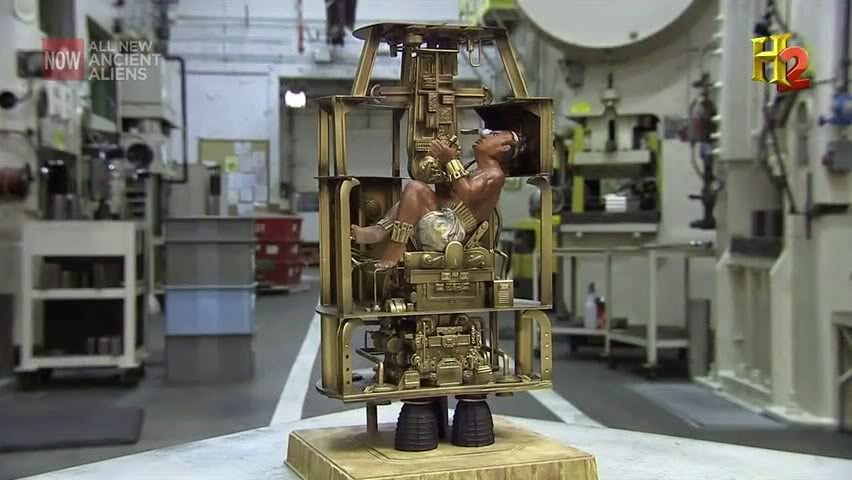
Discovered within the Temple of the Inscriptions at Palenque in 1952 is a limestone sarcophagus bearing the engraving of an "astronaut". Dating from about about 683 A.D. it is a big piece of evidence favored by ancient alien theorists. The tomb is no longer accessible to visitors due to concerns about humidity damage to the carvings. (There is a replica of the burial chamber , including the sarcophagus cover, in Mexico City's Museum of Archaeology.) When I saw this image in Palenque I thought, yes, it does look like a depiction of an astronaut. There he was, reclining in some sort of capsule, connected to life-support systems, apparently controlling what looks like a flame-propelled vehicle. It is quite astonishing, but who knows what it really represents? Debunkers have said it is simply a depiction of the transition to the afterlife using common Mayan symbols. Even if it is an astronaut, is it an alien astronaut or a human astronaut? Historians could certainly fashion any number of theories about this one image; it would be impossible to know for sure. Of course, the proponents of ancient alien influence on humans don't rely on this single piece of evidence. However, I would only rate this tantalizing tidbit five on a scale of one to ten on the ancient alien evidence scale.
![]() |
| 3. Sarcophagus cover at Palenque. |
![]() |
| 4. Detail. |
![]() |
| 5. Three dimensional model featured on the History Channel. |
![]() |
| 6. Close up of 3-D model. |
Nazca
The second site that impressed me was the Nazca Lines in the Atacama desert of Peru. Created between 400 and 650 A.D. these lines form images of birds, spiders, fish, monkeys, lizards and other animals. Some lines look like directional information for navigation.![]() |
| 7. Hummingbird. |
![]() |
| 8. "Landing strip." |
![]() |
| 9. Spider image in center of image surrounded by seemingly random straight lines. |
![]() |
| 10. Bird image. |
![]() |
| 11. Map of Nazca lines. |
Sacsayhuaman
Finally, the third interesting site I keep returning to in my mind is Sacsayhuaman. Located at an elevation of 12,000 feet it is a short distance north of Cuzco, Peru, Sacsayhuaman is an Incan fortress (in ruins). For me, this site offers more compelling evidence of technology beyond the abilities of a culture that didn't have the modern machines or even the benefits of the wheel.We'll explore Sacsayhuaman in the next blog entry.
![]() |
| 12. Author at Sacsayhuaman. |
1. History channel.
2. Tato Grasso.
3-4. Unknown.
5-6. History channel.
7-10. MJK
11. Unknown.
12. MJK
Friday, June 27, 2014
Architectural Hardscape
![]() |
| A bridge over a freeway. |
Architecture never exists in a vacuum. Any work of architecture never truly looks great unless the interior design looks great, the landscape architecture is complementary, and the hardscape (developer speak for all hard surfaces: roads, parking lot, lighting, sidewalks) is well designed.
Above is a picture of hardscape in my neighborhood, a bridge over a freeway. This was designed and built as a unified structure. It is part of a big freeway expansion project and is repeated many times over the same freeway. Presumably some time and effort went into the design of these bridges. Yet, it is not a coherent design.
Q. What is wrong with is picture?
A. Nothing goes together.
![]() |
| Contemporary sidewalk lights. More decorative than functional. |
The decorative sidewalk lights are designed to shine upward and reflect light off the curved hood down to the sidewalk. Not a bad contemporary design but the light they provide disappears in the surrounding street lights and freeway glare. These little lights provide precious little light. They should be called darks.
![]() |
| Traditional street lights. |
What's wrong with this picture?
![]() |
| A melange of hardscape design features. |
Photos: MJK
Labels:
Architectural Oddities,
Critique,
Opinion,
Ramblings
Monday, September 23, 2013
Architectural Images
Occasionally my friend, Lucille, forwards stunning photographs harvested on the Internet. Sometimes they include images of architecture, caught in moments of sublime beauty. Here are a few worth passing along.
![]() |
| Abandoned New York City subway tunnel. |
![]() |
| Dubai. |
![]() |
| Castle in Werfen, Austria. |
![]() |
| Tambian Lake, Indonesia. |
![]() |
| Terra forming the Palm Islands, Dubai. |
![]() |
| A house on a rock. |
![]() |
| Burma. |
![]() |
| Dubai at night. |
![]() |
| Manarola, Italy. |
![]() |
| Buddhist monks, lantern lighting ceremony. |
![]() |
| Morning in Tuscany. |
![]() |
| Neuschwanstein Caste, Germany. |
![]() |
| St. Stephen Island, Norway. |
![]() |
| Cliff side village. |
Thursday, November 29, 2012
Half-A-Cup of Architecture
There is a shopping center near my house that is nice enough, as shopping centers go. It has a quasi-prairie style demeanor with hip roofs and broad overhangs. It supports a useful assortment of shops: Pier One, Petsmart, a couple of banks, and the obligatory Starbucks.
The architecture softens a big box venue, Office Max, as well as can be done. But every time I visit the center I'm disappointed by a potentially good design that has dropped the ball. The hip roof motif looks great from certain angles (head on) but from other vantage points the hip roofs are severed like useless appendages. Worse: when viewed from the rear, the hips turn into aluminum-paneled gables.

Some people view things as a cup half full and others as a cup half empty. Either way, these chopped-off hip roofs are half-a-cup of architecture. They are incomplete; fake; deceptive. Obviously, these phantom roofs are a way to simplify (cheapen) the design. The architects probably thought we would never notice. They appear to have succumbed to a common pitfall amongst architects and developers: designing a building from the front, forgetting that we live in a three-dimensional world. This shopping center sprawls over three city blocks, surrounded on four sides by busy streets. It is impossible not to see the architecture from all sides.
We are constantly exposed to this type of facade-ism: buildings designed like storefronts in a western movie. A Flatland world where a building is imagined to exist only in one dimension. Then we turn the corner and realize half of it is fake. A pretentious facade designed to make us think the building is more important than it really is.
We are inundated with this attitude in residential architecture. Many houses are built with brick facades facing the street and cheaper materials around the sides. This is so common we don't think much about it anymore. It has almost become a style in itself. Maligned by thinking architects over the years, facade-ism is sometimes addressed (somewhat defensively) by taking a wee bit of brick around the corner (see, we really are three-dimensional) but then suddenly quitting the more expensive material for something cheaper. This strategy can work only if the expensive material ends in a graceful way, such as at a jog in the building or by completing a column. All too often it is an empty gesture that only emphasizes the haplessness of the architect and/or the developer. Better to leave the brick off altogether than expose the vacuity of style in a half-hearted attempt at three-dimensional thinking.
Kinda makes you thirsty for a full cup of architecture.
| A neighborhood shopping center. |
| Phantom hip, above. Details, below. |

Some people view things as a cup half full and others as a cup half empty. Either way, these chopped-off hip roofs are half-a-cup of architecture. They are incomplete; fake; deceptive. Obviously, these phantom roofs are a way to simplify (cheapen) the design. The architects probably thought we would never notice. They appear to have succumbed to a common pitfall amongst architects and developers: designing a building from the front, forgetting that we live in a three-dimensional world. This shopping center sprawls over three city blocks, surrounded on four sides by busy streets. It is impossible not to see the architecture from all sides.
![]() |
| Main street in an old west town. |
![]() |
| The set for Mel Brooks's Blazing Saddles. |
| A "spec" house under construction. |
![]() |
| Reductio ad absurdum: a storage shed in facade-ism style. |
Labels:
Architectural Oddities,
Critique,
Denver,
Design Ideas,
Opinion,
Philosophy,
Theory
Subscribe to:
Posts (Atom)