Monday, April 20, 2015

Alien Architecture at Sacsayhuaman

1. Large scale terrace walls at Sacsayhuaman.
Previously we explored the idea of ancient extraterrestrial artifacts at two sites: Palenque, Mexico and Nazca, Peru.

The third interesting site I keep returning to in my mind is Sacsayhuaman, Peru. It is the most remarkable of the sites referred to on the History Channel's Ancient Aliens that I have actually visited. Located at an elevation of 12,000 feet a short distance north of Cuzco, Sacsayhuaman was an Inca fortress. It is now in ruins, plundered, as usual, by the Spanish conquistadores.  Besides killing countless native South Americans, they looted the Inca culture for gold and silver, drove the native religion underground, and decimated their monuments. The conquistadores did a thorough job of plundering Sacsayhuaman, hauling away anything that was movable. What remains is not movable and that is what is remarkable.
2. Juan de Dios, Peruvian guide at Sacsayhuaman. 
Sacsayhuaman provides compelling evidence of technologies beyond the abilities of a culture that didn't even have the benefits of the wheel.*

Consider that the battlement walls of Sacsayhuaman are built of enormous andesite stones found nowhere near the site.  They are believed to originate from several quarries ranging 12 to 46 miles distant.  The largest stones weigh 128 to 200 tons. They were apparently hauled -- somehow -- over severe terrain. Conventional theories on transporting them usually mention a combination of ropes, ramps, and the labor of hundreds or thousands of workers. The details vary, because nobody really knows for sure.
3. Stone work detail.
4. Along the battlements. 
The stones are shaped not into squares or rectangles or any regular geometry, but into puzzle-like pieces with precisely rounded edges. Then - the most astonishing aspect of the whole thing - these misshapen pieces are lifted to great heights and assembled perfectly without mortar.  The results are so precise you can't slip a dollar bill (or a Peruvian Nuevo Sol) between the joints. Or, as Pedro Pizarro (brother of the conqueror Francisco Pizarro) said of Sacsayhuaman, "...the point of a pin could not have been inserted in the joints."
5. Remnants of a portal.
When I encountered Sacsayhuaman my first thought as an architect was, I don't know how I would begin to go about designing this today. How would one do working drawings, even using computers?  How would the masonry contractor react?  You want me to ship these 200 ton stones forty miles? Then carve them into absurd shapes? And set them flawlessly? Buddy; that ain't gonna happen no matter how many ropes you give me!

Even if one would and could draw it, where would an architect find the technology and craftsmanship to build it? The enterprise isn't rational.  It would be much simpler to use regular sized blocks with regular shapes and stack them together like other masonry structures. Using the most sophisticated techniques available to modern man, Sacsayhuaman seems impossible. So how the heck did the Incas ever accomplish such feats?
6. Terraces form the base of Sacsayhuaman. 

7. Rocks above the main terraces were removed by the Spaniards to build
homes and churches in Cuzco.  What remains was too big to move using
technology available to the conquistadores.
Ancient Aliens suggests, of course, that the Inca had help from ancient aliens. Their reasoning rests on the premise that humans couldn't have constructed it (because we didn't possess the skills or technology) therefore a different intelligence must have provided assistance.  The back-up evidence, as in all Ancient Alien episodes, includes other artifacts, carvings, or connections to distant sites that suggest extraterrestrial life forms. It is all conjecture, put forward by "ancient alien theorists" as if that were equivalent to "respected archaeologists."  As stated previously, all of this is frequently debunked on line; the evidence is not as airtight as the TV program would have it.

However, the case for ancient aliens, as evidenced at Sacsayhuaman and numerous other sites, is strong enough to make you wonder about it. For me, Sacsayhuaman is a place of great mystery. I don't understand exactly how or why it was built. I don't buy the explanations of mainstream historians and archaeologists; they seem as facile and contradictory as those offered by "ancient alien theorists." But that doesn't mean I accept the ancient alien hypothesis. The best I can say is I don't know how it was built and I don't think anybody does for sure.

Did extraterrestrials assist in the architecture and construction of Sacsayhuaman?  Maybe they did and maybe they didn't.
8. Terrace walls. 
* The wheel is said to have been unknown to native cultures in pre-Hispanic South America.  However, I saw what appeared to be an ancient wheel in nearby Ollantaytambo.  But that's another story. 

Images:
1. David Galsworthy
2-5. MJK
6-8. Luis Manuel Moll Juan

Sunday, March 29, 2015

Alien Architecture

Ancient Aliens

A popular show on cable TV is Ancient Aliens airing on the History channel. The show posits that ancient civilizations, such as the Egyptians and the Incas, produced architecture and artifacts that were too sophisticated to have emerged solely from human intelligence and abilities.  According to the show's explosively coiffed narrator,  Giorgio Tsoukalos, these great civilizations must have had assistance from a more advanced source: ancient aliens from another world. The evidence presented for this idea is sourced from vanished cultures around the world. If you are familiar with the theories of Erich von Daniken, you know the show's basic premise.
1. George Tsoukalos.
I got hooked on the show because the presentation of this evidence involves field trips to ancient ruins around the globe and computer-generated reconstructions of architectural monuments. It is worth watching as an exciting architectural travelogue if for no other reason.

Of course, the show has its debunkers. You can easily find on-line critics who delight in identifying inconsistencies within the show and errors of historical fact. These comments must be weighed against the contentions of the show's gaggle of scientific "experts" who are eager to claim any mystery as evidence of other-worldly intelligence.

When looking at ancient cultures there are bound to be mysteries.  Too much information has been lost to time to be able to fully understand how people in the distant past thought, how they lived their lives, and exactly how they built the monuments they left behind.  Sometimes it is better to say we simply don't know something than to build explanatory tales around tiny shreds of evidence.  There is much conjecture propping up in every episode of Ancient Aliens. That is not the same thing as scientific evidence.

And yet...

Sometimes the evidence is seductive. It occurs to me that - as an architect  - I could be one of the "experts" on this show. I am certainly as qualified as any of the UFOlogists introduced on the History channel. I have the professional qualifications to offer opinions on the built environment. And I have visited many of the sites that are of frequent interest to the show's producers:  Machu Picchu, Stonehenge, Chichenitza, Palenque, the Nazca Lines, Teotihuacan, Stonehenge, Sachayhuaman. So here it goes: I'm weighing in on the general thesis of Ancient Aliens.

Have great human endeavors in the past been aided by intelligent life from other planets?


Palenque

2. Temple of the Inscriptions. Palenque, Mexico. 
Of the ancient sites featured on Ancient Aliens that  I have actually visited, three stand out.  The first is the Mayan ruins at Palenque, Mexico.  Set deep in a misty jungle, Palenque possesses a movie-set romanticism that encourages other-worldly thoughts.

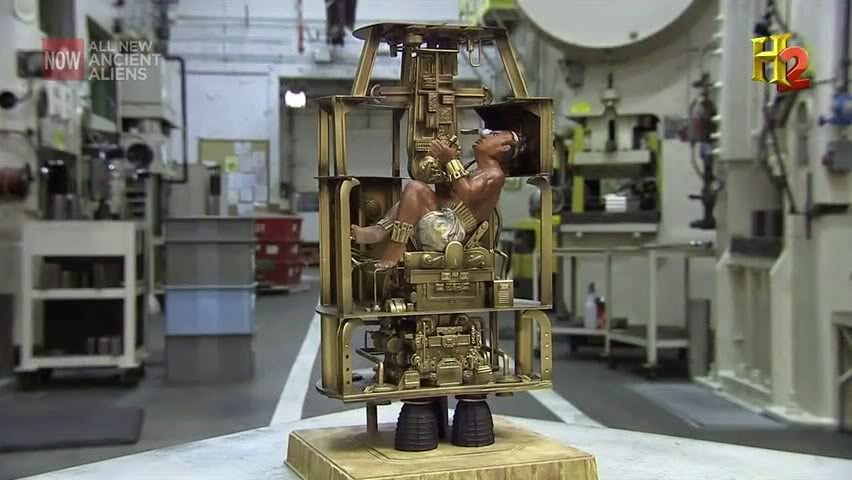
Discovered within the Temple of the Inscriptions at Palenque in 1952 is a limestone sarcophagus bearing the engraving of an "astronaut".  Dating from about about 683 A.D. it is a big piece of evidence favored by ancient alien theorists. The tomb is no longer accessible to visitors due to concerns about humidity damage to the carvings. (There is a replica of the burial chamber , including the sarcophagus cover, in Mexico City's Museum of Archaeology.) When I saw this image in Palenque I thought,  yes, it does look like a depiction of an astronaut.  There he was, reclining in some sort of capsule, connected to life-support systems, apparently controlling what looks like a flame-propelled vehicle.  It is quite astonishing, but who knows what it really represents?  Debunkers have said it is simply a depiction of the transition to the afterlife using common Mayan symbols.  Even if it is an astronaut, is it an alien astronaut or a human astronaut? Historians could certainly fashion any number of theories about this one image; it would be impossible to know for sure. Of course, the proponents of ancient alien influence on humans don't rely on this single piece of evidence. However, I would only rate this tantalizing tidbit five on a scale of one to ten on the ancient alien evidence scale.
3. Sarcophagus cover at Palenque.
4. Detail. 
5. Three dimensional model featured on the History Channel.
6. Close up of 3-D model. 

Nazca

The second site that impressed me was the Nazca Lines in the Atacama desert of Peru. Created between 400 and 650 A.D. these lines form images of birds, spiders, fish, monkeys, lizards and other animals. Some lines look like directional information for navigation.
7. Hummingbird.
Other artificial formations in the region look like landing strips. These glyphs are only fully visible from aloft. People ask why are they here? What are they for?  To some, the only logical explanation is signals to creatures who had the technology to fly, i.e. ancient aliens. There are other explanations, of course. When I was there a popular theory was that these were ritual paths carved into the desert by hundreds of footsteps tracing their way over and over again. Sort of like walking the labyrinth in the cathedral at Chartres. This does seem possible. It would not take elevated sight to work out the geometry of a path that formed a recognizable image. That might explain how the images were created; it still leaves questions of why and for whom. Keep in mind these images are huge and many. And it is not just lines, it is rock formations and altered  landscapes in the surrounding hills that are provocative.  The Nazca lines, taken as a whole,  seem beyond the abilities of the humans formerly inhabiting this area. However, it could be that we under estimate those abilities. Or, at least, misunderstand the cultural needs of those people. The lines are suggestive evidence for extraterrestrial intelligence, but I don't think we can call it proof. I'll rate this site another five on the ancient alien evidence scale.
8. "Landing strip."
9. Spider image in center of image surrounded
by seemingly random straight lines.
10. Bird image.
11. Map of Nazca lines.

Sacsayhuaman

Finally, the third interesting site I keep returning to in my mind is Sacsayhuaman. Located at an elevation of 12,000 feet it is a short distance north of Cuzco, Peru, Sacsayhuaman is an Incan fortress (in ruins).  For me, this site offers more compelling evidence of technology beyond the abilities of a culture that didn't have the modern machines or even the benefits of the wheel.

We'll explore Sacsayhuaman in the next blog entry.
12. Author at Sacsayhuaman.
Photos:
1. History channel.
2. Tato Grasso.
3-4. Unknown.
5-6. History channel.
7-10.  MJK
11. Unknown.
12. MJK

Sunday, November 23, 2014

Bruce Goff: Architect and Painter

Bavinger House
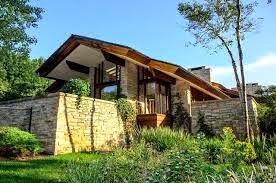
Bruce Goff (1904-1982) was one of our most important mid-century American architects. He was a follower of Frank Lloyd Wright but a steadfast purveyor of his own unique aesthetic. Goff is perhaps most famous for the nautilus-shaped Bavinger House (Norman, OK) and the crystalline Price House (Bartlesville, OK). Though his architecture is widely published and critically acclaimed, few people know Goff was also an accomplished and prolific painter. Goff created paintings as exercises to free his mind. Usually working with tempera on wet construction paper, he would start with serendipitous runs of random color.  Treating these amorphous shapes as a given from nature, he would bring them under control with mixed media: gold paint, colored pencils, geometric stencils.
Price House.
Recently I was sorting through some of my old slides as the start of a long-delayed project to convert them to digital format. (Who even owns a slide projector anymore?) Tucked in with the thousands of architectural slides in my collection was a treasure trove of Bruce Goff paintings.  These images were given to me years ago by a Goff apprentice, John Bowles.  I hadn't looked at these slides in years, but I am as impressed now as I was when I first saw them. Goff's paintings are abstract, but they span a variety of styles that could stand proudly with the works of the most acclaimed twentieth century artists.  There are even a few rare examples of non-abstract figures (from a series called "The Drunken Boat" inspired by the Arthur Rimbaud poem) which demonstrate Goff's charming illustrative skill.  A couple of paintings contain Goff's squircle invention (a square morphing into a circle). Here are a few of my favourite Goff paintings from this collection.


Monday, October 20, 2014

Architecture in the Movies (E. Fay Jones?)

I love it when great architecture shows up in the movies. A few examples are Wright's Ennis house  in Bladerunner, Lautner's Elrod house in The Big Lebowski, and, more recently, the futuristic architecture of Shanghai in Her.
Usually we experience architecture in the form of still photos, unless we're lucky enough to visit a site in person. Photos are ghosts of the real experience. They are static, lifeless, and often tell lies. Movies come closer to simulating the actual experience of architecture.  As the camera pans we get a three dimensional sense of space. It is still not equivalent to the real thing. It lacks smell, texture, and the volition to explore. Movies are more of a "through the peephole" type of experience: limited in scope and participation. Nevertheless, it's fun to see great spaces spring to life in cinematic scope.
I was recently surprised by a rich sample of architecture in Gone Girl, the new Ben Affleck movie. A secondary, but important character, Desi (played by Neil Patrick Harris) owns a lake house that is central to the plot. The lake house, featured in several extended scenes, is Frank Lloyd Wright on steroids. It is, I think, one of E. Fay Jones' inimitable works. However, I've been wrong about Jones attributions in the past and I can't find pictures of the "lake house" in my library or on the web. If any reader knows E. Fay Jones' work well enough to ID the Gone Girl lake house, please leave a comment.
In the meantime, I will say that by the time the house popped up in the movie I was sufficiently disengaged from the plot to thoroughly enjoy the architectural relief. However, movie critics gave Gone Girl good reviews. So don't be turned away from the movie because I got distracted. And in lieu of pictures of this specific house, here are a few examples of E. Fay Jones' work culled from the internet.


P.S. In the process of doing my internet search for the E. Fay Jones house in question, I ran across a link to my blog and it's misidentification of a church in Nebraska that looks like Jones' work, but is not. Take that as a warning to the wise that you can't trust everything you see on the web... even if it comes from this blog! Read my original Jones comments and reader comments at
A Religious Experience on Interstate 80.

Friday, June 27, 2014

Architectural Hardscape

A bridge over a freeway.
Architecture never exists in a vacuum. Any work of architecture never truly looks great unless the interior design looks great, the landscape architecture is complementary, and the hardscape (developer speak for all hard surfaces: roads, parking lot, lighting, sidewalks) is well designed.
Above is a picture of hardscape in my neighborhood, a bridge over a freeway. This was designed and built as  a unified structure.  It is part of a big freeway expansion project and is repeated many times over the same freeway.  Presumably some time and effort went into the design of these bridges. Yet, it is not a coherent design. 

Q. What is wrong with is picture? 

A. Nothing goes together. 

Contemporary sidewalk lights. More decorative than functional.

The decorative sidewalk lights are designed to shine upward and reflect light off the curved hood down to the sidewalk. Not a bad contemporary design but the light they provide disappears in the surrounding street lights and freeway glare. These little lights provide precious little light. They should be called darks.  
Traditional street lights. 
Perhaps in recognition of the inefficacy of the pedestrian lights, slightly taller street lights are spaced regularly along the bridge. They provide adequate light for cars and pedestrians, but the traditional design of the taller lights has no relationship to the smaller contemporary lights. It is as if the two came from different centuries - the nineteenth and the twenty-first   No one bothered to coordinate the spacing of the tall lights to the smaller ones.  Sometimes they are close together, sometimes far apart. (Nice team effort there.) Furthermore, neither the tall lights nor the short lights have any design relationship to the street lighting in the neighborhoods on either side of the bridge or the more functional freeway lighting elsewhere. Any contextual reference is nonexistent. Doesn't anyone bother to consider these things?
  
What's wrong with this picture?  


A melange of hardscape design features. 
Photos: MJK

Tuesday, June 24, 2014

Architectural Hardscape the Right Way


Continuing the discussion on architectural hardscape: there are good ways to do it. Sometimes outdoor art is part of the hardscape, making pathways, plazas, gardens and buildings more interesting. There is no better example of art mixing with landscaping and the built environment than the current exhibit of Dale Chihuly glass art at the Denver Botanic Gardens. The accompanying iPhone pictures hardly do justice to the spectacular glass installations. For more on the artist and his work (and much better pictures) click on http://www.chihuly.com. For more information on the Denver exhibit, see link below.


Chihuly